Welcome to the ACT practice test page!
Click the “Start Test” button above to begin our free ACT practice test! These ACT practice questions will give you a better idea of what to study for your exam.
ACT Practice Tests by Subject
If you need some extra practice in a specific subject, click one of the subjects below to get started on a subject-specific ACT practice test.
Good luck with your studying!
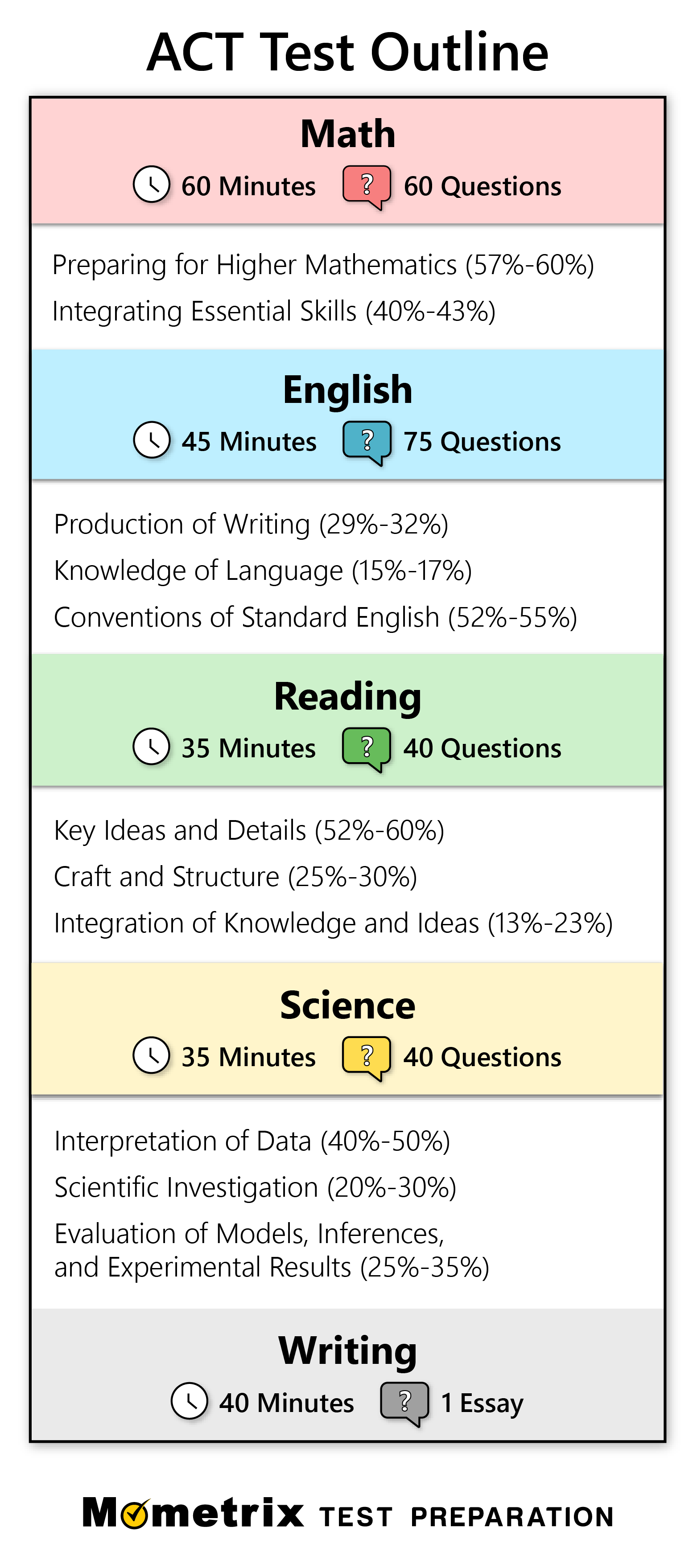
ACT Test Outline
The ACT is split into four sections (plus an optional fifth section). You will be given about 3 hours to complete the full test, which is made up of 215 multiple-choice questions.
Check Out Mometrix's ACT Printed Study Guide
Get practice questions, video tutorials, and detailed study lessons
Get Your Study Guide
ACT Online Prep Course
If you want to be fully prepared, Mometrix offers an online ACT Prep Course. The course is designed to provide you with any and every resource you might want while studying. The ACT Course includes:
- 75 Lessons Covering Every
- 1,500+ ACT Practice Questions
- Over 280 Video Tutorials
- More than 350 Electronic Flashcards
- Money-back Guarantee
- Free Mobile Access
- and More!
The ACT Prep Course is designed to help any learner get everything they need to prepare for their ACT exam. Click below to check it out!

How to Study for the ACT
How to Study Effectively
Your success on ACT test day depends not only on how many hours you put into preparing but also on whether you prepared the right way. It’s good to check along the way to see whether your studying is paying off. One of the most effective ways to do this is by taking ACT practice tests to evaluate your progress. Practice tests are useful because they show exactly where you need to improve. Every time you take a free ACT exam practice test, pay special attention to these three groups of questions:
- The questions you got wrong
- The ones you had to guess on, even if you guessed right
- The ones you found difficult or slow to work through
This will show you exactly what your weak areas are and where you need to devote more study time. Ask yourself why each of these questions gave you trouble. Was it because you didn’t understand the material? Was it because you didn’t remember the vocabulary? Do you need more repetitions on this type of question to build speed and confidence? Dig into those questions and figure out how you can strengthen your weak areas as you go back to review the material.
Answer Explanations
Additionally, many ACT practice tests have a section explaining the answer choices. It can be tempting to read the explanation and think that you now have a good understanding of the concept. However, an explanation likely only covers part of the question’s broader context. Even if the explanation makes sense, go back and investigate every concept related to the question until you’re positive you have a thorough understanding.
Comprehend Each Topic
As you go along, keep in mind that the ACT practice test is just that: practice. Memorizing these questions and answers will not be very helpful on the actual test because it is unlikely to have any of the same exact questions. If you only know the right answers to the sample questions, you won’t be prepared for the real thing. Study the concepts until you understand them fully, and then you’ll be able to answer any question that shows up on the test.
Strategy for ACT Practice
When you’re ready to start taking practice tests, follow this strategy:
- Remove Limitations. Take the first test with no time constraints and with your notes and ACT study guide handy. Take your time and focus on applying the strategies you’ve learned.
- Time Yourself. Take the second practice test “open book” as well, but set a timer and practice pacing yourself to finish in time.
- Simulate Test Day. Take any other practice tests as if it were test day. Set a timer and put away your study materials. Sit at a table or desk in a quiet room, imagine yourself at the testing center, and answer questions as quickly and accurately as possible.
- Keep Practicing. Keep taking practice tests on a regular basis until you run out of practice tests or it’s time for the actual test. Your mind will be ready for the schedule and stress of test day, and you’ll be able to focus on recalling the material you’ve learned.
Check Out Mometrix's ACT Flashcards
Get complex subjects broken down into easily understandable concepts
Get Your Flashcards